
For manufacturers, factory floor space is not just a physical asset, it is a revenue driver. Every square metre used to store raw materials or finished goods is a square metre not contributing to production.
This creates a clear operational trade-off. To address this, many manufacturers are turning to 3PL warehousing to move bulk storage off-site, freeing up space for production, improving workflow, and removing constraints that limit output.
This approach often referred to as manufacturing warehouse outsourcing allows businesses to separate storage from production. The result is a more efficient, scalable operation where the factory floor is dedicated to what it does best: producing goods.
The Hidden Cost of On-Site Storage
In many facilities, storage expands gradually. As demand increases, inventory begins to occupy production zones, aisles, and temporary racking areas. While this may seem manageable, it introduces ongoing inefficiencies that directly affect performance.
Common impacts include:
- Reduced production capacity: Space tied up with pallets limits the ability to expand machinery or production lines
- Slower internal movement: Congested layouts increase travel time for forklifts and staff
- Higher safety risk: Mixed-use areas (storage and production) increase the likelihood of incidents
- Limited flexibility: Difficulty scaling operations during peak demand or large inbound deliveries
From a commercial perspective, the issue is straightforward: storage does not generate revenue, production does.
What Manufacturing Warehouse Outsourcing Looks Like
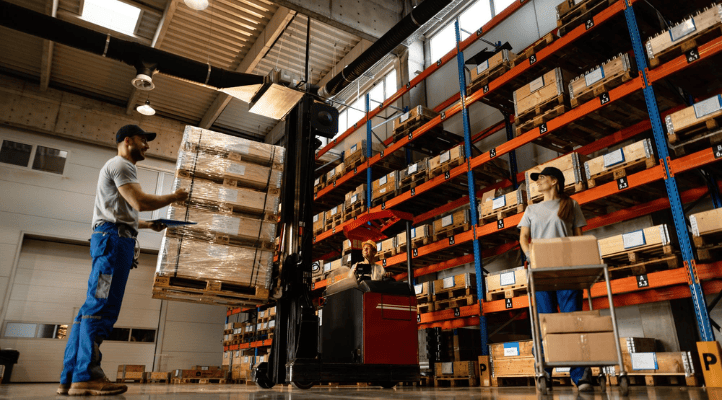
Manufacturing warehouse outsourcing involves using a 3PL provider to manage off-site storage and inbound logistics. Instead of holding large volumes of stock at the factory, inventory is stored in a purpose-built warehouse designed for efficient pallet handling and high-density storage.
At TW Logistics, this model is centred on full pallet in / out operations. Manufacturers hold only the stock required for immediate production, while bulk inventory is stored securely off-site and delivered as needed.
This creates a cleaner, more controlled production environment without compromising stock availability.
Reclaiming Space Through Production Footprint Optimisation
Moving bulk storage off-site allows manufacturers to rethink how their floor space is used. Rather than allocating large areas to static inventory, that space can be reassigned to production-focused activities such as:
- Expanding or adding production lines
- Improving assembly layouts
- Creating dedicated staging areas for active jobs
- Increasing access and movement efficiency across the site
This shift improves overall factory floor utilisation and removes the physical limitations that often restrict growth.
Improving Inbound Inventory Flow
Inbound logistics is one of the main contributors to factory congestion. Bulk deliveries, particularly container loads, require space for unloading, sorting, and staging before use.
A 3PL warehouse simplifies this process by handling:
- Container destuffing: Goods are unloaded and palletised off-site
- Inbound inventory staging: Stock is organised before arriving at the factory
- Scheduled replenishment: Deliveries are aligned with production requirements
This reduces the need for large staging zones within the factory and ensures materials arrive in manageable quantities. The result is a more predictable and efficient workflow.
Removing Bottlenecks from the Factory Floor
When storage, handling, and production occur in the same space, inefficiencies are inevitable. Congestion, double handling, and restricted access all contribute to bottlenecks.
By separating storage from production, manufacturers can:
- Maintain clear, dedicated production areas
- Reduce unnecessary forklift movement
- Improve access and visibility across the floor
- Align inventory flow with production schedules
This creates a more streamlined operation where each function is performed in the right environment.
Supporting Industrial Stock Inbound Logistics
Managing industrial stock inbound logistics requires infrastructure, systems, and consistency. A dedicated 3PL warehouse is designed to handle these requirements at scale.
TW Logistics supports this through:
- High-bay racking systems for efficient pallet storage
- Dedicated loading bays for smooth transport movements
- Structured receiving processes for large inbound volumes
- Advanced inventory systems for real-time stock visibility
By moving these functions off-site, manufacturers reduce operational complexity while maintaining full control over their inventory.
Overflow Pallet Storage in Melbourne
For manufacturers operating in Melbourne, space constraints are a common challenge. Expanding a facility is often costly and time-consuming, particularly in established industrial areas.
Overflow pallet storage provides a practical alternative. Instead of committing to additional floor space or disrupting operations, businesses can:
- Store excess or seasonal inventory off-site
- Maintain consistent production without interruption
- Adjust storage capacity as demand changes
This flexibility is particularly useful during peak periods or when managing fluctuating supply chains.
Improving Safety on the Factory Floor
A well-organised factory is a safer factory. Excess stock, blocked aisles, and mixed-use areas increase the risk of incidents and make compliance more difficult.
Using a 3PL to manage storage helps:
- Keep walkways and access points clear
- Reduce on-site materials handling
- Maintain separation between pedestrians and machinery
- Support a more controlled and compliant environment
This not only protects staff but also contributes to smoother daily operations.
A More Scalable Operating Model
One of the key advantages of factory storage solutions through 3PL is scalability. Storage requirements change with production demand, and fixed on-site space cannot always adapt.
With a 3PL partner, manufacturers gain:
- Flexible storage capacity without capital investment
- The ability to scale up during peak demand
- Reduced pressure on internal resources
- A cost structure aligned with actual usage
This allows businesses to grow without being limited by physical space.
Why Work with TW Logistics
TW Logistics provides 3PL warehousing solutions designed for manufacturers that rely on efficient, full pallet storage and consistent inbound logistics.
Our approach focuses on:
- Full pallet in / out operations
- Modern, well-organised warehouse infrastructure
- Reliable handling of industrial stock
- Clear visibility across inventory movements
We help manufacturers reduce congestion on-site, improve workflow, and create space for production to scale.
In Summary
Factory floor space should be used for production, not storage. When bulk inventory occupies valuable space, it limits output, creates inefficiencies, and restricts growth.
By using 3PL warehousing, manufacturers can shift storage off-site, improve factory floor utilisation, and operate more efficiently. The result is a cleaner, safer, and more scalable production environment.
Call our TW Logistics team to discuss a tailored 3PL storage and inbound logistics solution that unbottlenecks your factory floor.