
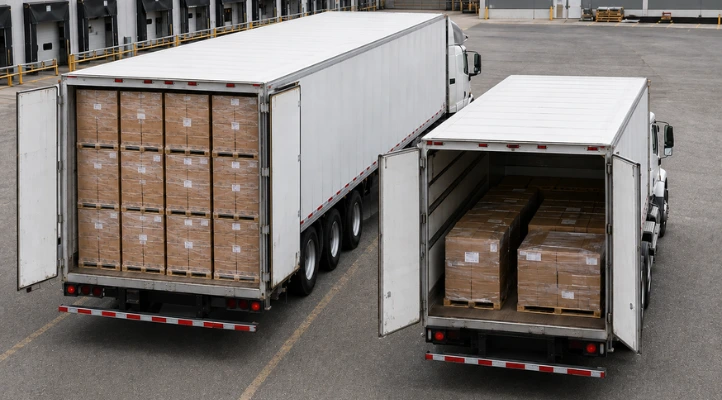
Choosing between FTL (Full Truckload) and LTL (Less Than Truckload) freight comes down to your shipment size, budget and delivery timeframe. FTL suits businesses with enough freight to fill a whole truck or who need a dedicated, direct run, while LTL suits smaller loads that can share space with other consignments to keep costs down.
Getting this decision right affects your freight costs, transit times, and how your goods are handled along the way, so it is worth understanding both options before you book your next shipment.
What is FTL (Full Truckload)?
FTL freight means your goods take up an entire truck, whether that is a single large pallet run or a full load of general freight. The truck is booked exclusively for your business and travels directly from pickup to delivery without stopping to load or unload other customers’ freight along the way.
This makes FTL a strong option when you are moving:
- Large volumes of palletised or bulk freight
- Time-sensitive shipments that cannot afford delays from multiple stops
- Fragile or high-value goods that benefit from minimal handling
- Freight that needs to travel point to point without consolidation
Because the truck is dedicated to one shipment, FTL can offer faster transit times and reduce handling, which may help minimise the risk of damage.
What is LTL (Less Than Truckload)?
LTL freight is for businesses that do not have enough volume to fill a truck on their own. Instead, your freight shares space with other businesses’ shipments, and the transport provider consolidates multiple loads onto one vehicle to keep costs down for everyone involved.
LTL tends to suit:
- Smaller, regular freight movements
- Businesses without the volume to justify a dedicated truck
- Non-urgent freight where a slightly longer transit window is acceptable
- Cost-conscious shipments where price matters more than speed
Because LTL freight is consolidated with other loads, it usually involves more handling points and can take longer to reach its destination, particularly if it needs to be transferred between vehicles or routed through a depot.
If you are still weighing up your options, it can help to first understand how to choose freight transport in Melbourne more broadly, since matching shipment volume and frequency to the right service is the starting point for both FTL and LTL decisions.
Key Differences Between FTL and LTL
| Factor | FTL | LTL |
| Cost | Higher per shipment, lower per unit at volume | Lower per shipment, cost shared across freight |
| Speed | Direct, generally faster | Can be slower due to consolidation and multiple stops |
| Handling | Minimal, single load | More handling as freight is loaded and unloaded with others |
| Best for | Large or urgent shipments | Smaller, regular or budget-conscious shipments |
How to Decide Which Option Suits Your Business
There is no single right answer, it depends on what you are shipping and how often. A few practical questions can help guide the decision:
How much freight do you have? If your shipment fills, or nearly fills, a truck on its own, FTL is usually more cost-effective and efficient than trying to split it across LTL runs. If you are regularly moving smaller volumes, LTL keeps your freight costs proportional to what you are actually sending.
How time-sensitive is the delivery? Businesses with tight delivery windows, whether that is a customer commitment or a production deadline, often benefit from the directness of FTL. If your freight has more flexibility around delivery timing, LTL can be a more economical choice.
What is the nature of your goods? Fragile, high-value or dangerous goods often benefit from the reduced handling of FTL. Generally, well-packaged freight is usually well suited to LTL without added risk.
How consistent is your freight volume? Some businesses find their freight profile changes throughout the year, larger volumes during peak periods and smaller, more frequent shipments for the rest of the time. A transport partner who can offer both FTL and LTL options gives you the flexibility to match the service to the shipment, rather than committing to one model regardless of what you are sending.
Why This Decision Matters for Your Supply Chain
Freight costs and delivery reliability have a direct impact on your bottom line and customer service. Choosing the wrong option, paying for a dedicated truck you do not need, or squeezing urgent freight into a slower consolidated run, can quietly add cost and risk to your supply chain over time. Reviewing your freight profile regularly, rather than defaulting to the same option for every shipment, helps keep your transport spend aligned with your actual business needs.
This matters more in Melbourne than many businesses realise. Melbourne recorded the highest metropolitan road freight volume of any Australian capital city in 2022 to 2023, at 17.1 billion tonne kilometres. With that much freight moving through the city, the efficiency of your transport choices, FTL or LTL, has a real effect on how well your business can compete on cost and delivery times.
How TW Logistics Can Help
TW Logistics provides both FTL and LTL freight options across metropolitan Melbourne and regional Victoria, including Gippsland. With over 50 years of combined logistics experience, tailored schedules, modern and well-maintained fleet, our team works with you to match the right freight solution to your shipment size, timeframe and budget, rather than putting every business through the same process.
If your business regularly moves freight from regional Victoria to Gippsland, our freight services team can advise whether a dedicated FTL run, or a consolidated LTL delivery makes more sense for your route. And if storage is part of the equation too, our 3PL warehousing solutions can complement your transport plan, keeping stock ready to move as freight is needed.
Whether you need a dedicated truck for a large or time-sensitive delivery, or a cost-effective LTL solution for regular smaller shipments, TW Logistics can help you decide what makes sense for your business.
Contact our team today to discuss the right freight option for your next shipment.